

Why I Fell in Love With Full Face Mask Diving (And Why More UK Divers Should Try It)
If you had told me a few years ago that I’d be writing a blog, passionately advocating
for full face mask diving, I probably would have laughed at you. Back then I was just getting started in diving myself.
My journey into scuba actually began with a call to Bespoke Scuba Diving in 2022.
At the time, the plan was straightforward. Learn to dive - Get my PADI Open Water so I could enjoy the underwater world on my honeymoon in Mexico. I genuinely thought that would be it.
Do the course, tick the box, go on holiday.
Of course, as anyone who dives will know… it never works out that way.
Once you start diving, you realise very quickly that there is a whole world beneath
the surface — and that you’ve only just scratched it.

Fast forward through a whirlwind of courses, UK dives, amazing trips, the
Divemaster journey, the Instructor Development Course, and eventually becoming a
PADI Instructor, and suddenly diving had become far more than a hobby. It had
become something I genuinely wanted to share with other people.
And somewhere along that journey I discovered something that completely changed
the way I look at diving equipment: Full face masks. I would like to share Why I Fell in Love With Full Face Mask Diving.
The First Time I Tried One
I still remember the first dive that I did with a full-face mask with Bespoke Scuba.
Like most divers, I’d spent all my time diving the traditional way — mask on your
face, regulator in your mouth, biting down on that mouthpiece like your life depends
on it.........
Which, to be fair… it sort of does.
It’s just how diving works, right?
Then I descended with a full-face mask on for the first time.
I took a breath.
Then another.
And within about 10 seconds my brain went:
“Hang on… this is amazing!”
Because instead of biting a mouthpiece, I was just breathing.
Normally.
Through my nose.
Through my mouth.
Exactly the way you breathe on land.
It sounds like a small thing, but underwater it’s actually a massive difference. I
surfaced from that dive thinking something along the lines of:
“Why have I been chewing on a regulator when this exists?”

A Quick Word to Regulator Divers
Now before anyone starts accusing me of abandoning the traditional diving setup,
let’s be fair here.
Standard mask-and-regulator diving is brilliant. It’s simple, reliable, and it has taken
millions of divers safely underwater all around the world.
But… that doesn’t mean it’s the only way to dive.
And once you’ve tried a full-face mask, you suddenly realise some of the things
we’ve just accepted as “part of diving” are actually optional.
Things like jaw ache after a long dive, Dry mouth from holding a regulator, Trying to
talk on the surface while still biting a mouthpiece or even attempting to explain
something underwater using increasingly frantic hand signals.
You start to realise what we do as this is what we are taught
Meanwhile the full-face mask diver next to you is breathing normally and looking
suspiciously comfortable.
Why Full-Face Masks Are Perfect for UK Diving
Let’s talk about something all UK divers understand….Cold water!
Now don’t get me wrong, I love UK diving. Some of my favourite dives have been
right here at home. But nobody can pretend our water temperatures are exactly
tropical.
With a traditional setup, a large part of your face is exposed. Your lips, your nose,
and the whole lower part of your face are in the cold water the entire
dive. With a full-face mask, your entire breathing area is enclosed.
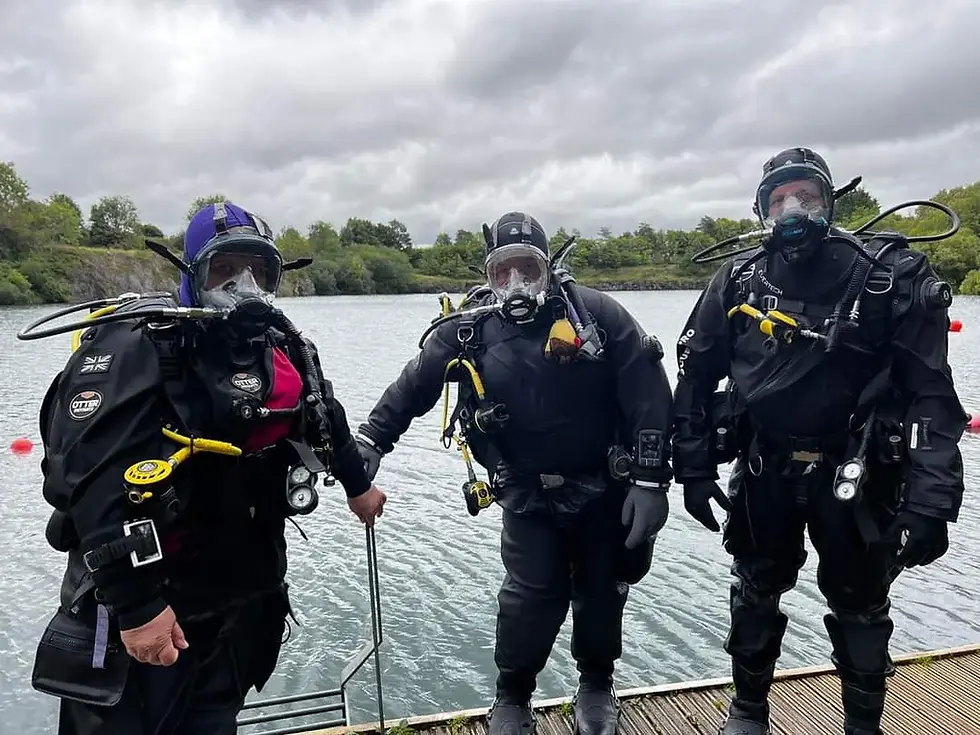
That means a lot Less heat loss, much more comfort and significantly fewer “why
can’t I feel my face?” moments after winter dives.
Anyone who has surfaced from a cold quarry dive trying to speak but sounding like
they’ve had dental anaesthetic will understand exactly what I mean.
Communication Underwater (Yes, Really)
One of the things that makes full face masks really interesting, especially from a
teaching perspective is underwater communication systems.
Many full-face masks can be fitted with comms units that allow divers to talk to each
other underwater.
The first time you hear someone speak underwater is a strange moment.
You’re floating along and suddenly a voice appears in your head.
But once you get used to it, it’s incredibly useful.
Especially when you’re teaching.
Instead of complicated signals you can simply say:
“Stay where you are.”
“Look over here.”
“Nice buoyancy!”
And if you’ve ever tried to correct someone’s finning technique using only hand
signals, you’ll appreciate how useful that can be!
Teaching the Full-Face Mask Course
One of the things I enjoy most as an instructor is teaching the PADI Full Face Mask
Specialty because there’s always a moment where the diver realises how good it
feels.
They descend.
Take a few breaths.
Then their eyes widen slightly and they give that look that says: “Oh… this is actually
brilliant.”
Of course, the course isn’t just about enjoying the mask. Like anything in diving, it’s
about learning how to use it properly and safely.
During the course we cover things like how full-face masks work, how to properly fit
and adjust the mask, emergency procedures, switching to a backup regulator and
removing and replacing the mask underwater.
Some of the skills are different from traditional diving procedures, but by the end of
the course divers are completely comfortable with the system.
And usually already planning how they’re going to get one - Of course like all scuba equipment - Bespoke Scuba Diving sells these!
Why I’m Advocating for FFM Diving in the UK
Full face masks still feel a bit niche in the UK recreational diving scene and are often
referred to as the ‘Marmite’ of diving equipment.
But they shouldn’t.
They’re comfortable, they’re practical and they open up possibilities like underwater
communication.
Most importantly though, they make diving feel incredibly natural, and once divers try
them, the reaction is almost always the same.
They surface smiling, start asking questions, then they want another dive.
Diving Is About Passion
If my journey in diving has taught me anything, it’s that this sport has a way of pulling
you deeper in.
What started as a simple Open Water course turned into Divemaster, then Instructor,
and now helping others discover the underwater world themselves.
Full face mask diving is just another part of that journey for me.
Something I genuinely enjoy diving with.
Something I enjoy teaching.
And something I’d love to see more divers in the UK experience.
Because once you try it, there’s a very good chance you’ll surface thinking exactly
what I did on that first dive:
“Why didn’t I try this sooner?”


Comments